
_edited.png)
Why Is My Cat Doing That? When Cats Play With the Wrong Things


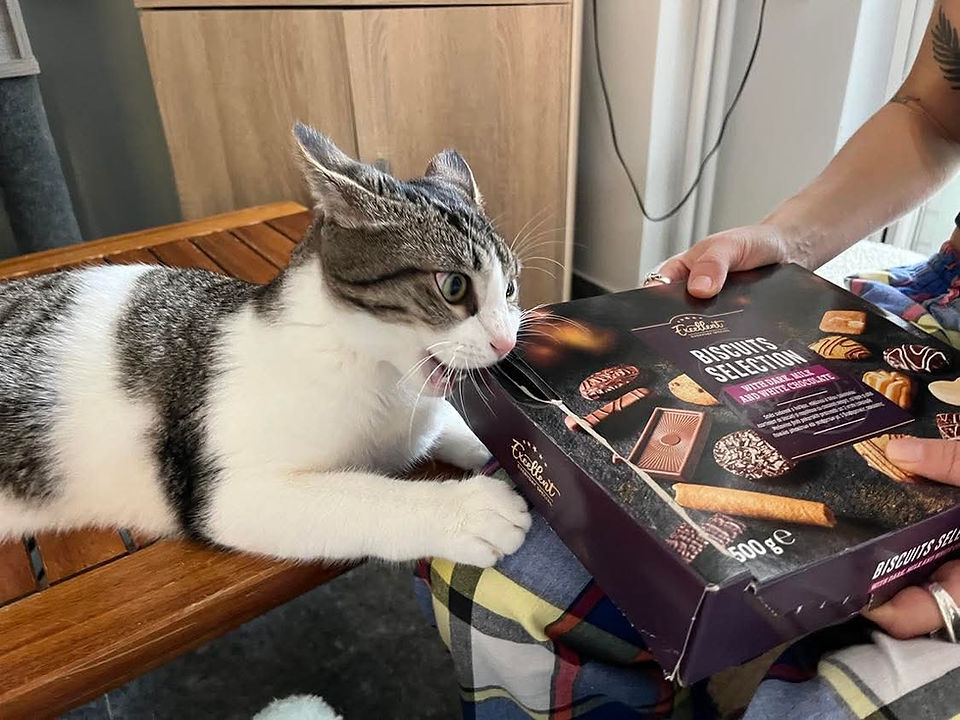


You bought the fancy toy. The wand with the feathers. The crinkle ball. The interactive puzzle that cost more than your lunch.
Your cat ignored all of it and spent forty minutes batting a hair tie across the kitchen floor, chewing the corner of your sofa, and — most bafflingly — playing with the contents of their litter tray.
If this sounds familiar, you are not alone. Cats are wonderfully, infuriatingly creative about what they choose to engage with, and the things they're most drawn to are not always the things we'd choose for them. Some of it is harmless and even amusing. Some of it is a sign that something needs to change. And some of it can be genuinely dangerous.
Here's what's really going on — and what to do about it.
Why Cats Play With "Wrong" Things in the First Place
Before we get into specifics, it helps to understand the drive behind the behaviour.
Cats are natural hunters. Every instinct they have — the stalking, the pouncing, the batting, the chasing — is rooted in predatory behaviour that kept their ancestors alive. In a domestic environment, that drive doesn't disappear. It looks for an outlet. And it will find one, whether you provide it or not.
When a cat chooses your furniture over their scratching post, or a hair tie over their toy mouse, it's rarely about being difficult. It's about texture, movement, scent, size, or simply the fact that the "wrong" thing happened to be more interesting in that moment. Understanding the why makes it much easier to redirect the behaviour effectively.
The Furniture — Sofas, Corners, and Carpets
This is the one that frustrates owners most. You have a scratching post. Your cat has chosen your sofa instead.
Why it happens: Scratching is not destructive behaviour — it is essential behaviour. Cats scratch to shed the outer layer of their claws, to stretch their muscles, and to mark their territory through both visual marks and scent glands in their paws. They are not doing it to upset you. They are doing it because they need to.
The reason they choose the sofa over the post often comes down to a few things: the post may be too small, too wobbly, or in the wrong location. Cats prefer to scratch in prominent, visible areas — often near where they sleep or spend time — not tucked away in a corner where you hoped it would be out of sight.
What to do:
Invest in a tall, sturdy scratching post — it needs to be tall enough for your cat to fully stretch upright, and stable enough not to wobble when used. Cats will abandon a post that feels unstable immediately.
Place it near where your cat already spends time, or next to the furniture they've been targeting.
Try different materials — some cats prefer sisal, others cardboard, others carpet. Experiment until you find what your cat responds to.
Use a cat-safe deterrent spray on the furniture you want to protect while you're redirecting the behaviour.
Never punish scratching — it is a need, not a choice. Redirect it.
Hair Ties, Rubber Bands, and Small Objects
Hair ties, rubber bands, bottle caps, small toys with removable parts — these are irresistible to many cats and genuinely dangerous to all of them.
Why it happens: Small, lightweight objects that move unpredictably are extraordinarily appealing to a cat's predatory instincts. They mimic the erratic movement of prey. The rubbery texture of hair ties in particular seems to satisfy something cats find deeply compelling — many will chew and swallow them given the chance.
Why it matters: Swallowed hair ties, rubber bands, string, tinsel, or any linear object can cause a potentially fatal intestinal obstruction or perforation. This is a veterinary emergency. It is not always obvious until it is serious.
What to do:
Store hair ties, rubber bands, and small loose objects completely out of reach — in drawers, not on surfaces.
If your cat is particularly drawn to chewing rubber or elastic, provide safe alternatives like designated chew toys designed for cats.
If you suspect your cat has swallowed something they shouldn't have — watch for vomiting, lethargy, loss of appetite, or changes in litter tray habits, and contact your vet immediately.
String, Wool, and Ribbon
String toys are wonderful for interactive play — under supervision. Left unattended, they become one of the most common causes of serious injury in cats.
Why it happens: Linear objects trigger a cat's chase-and-swallow instinct powerfully. The backwards-facing spines on a cat's tongue actually make it very difficult for them to spit string out once it's in their mouth — it tends to go further in instead.
What to do:
Never leave string, wool, ribbon, or wand toys accessible when you are not actively playing with your cat.
Pack them away after every play session — every single time.
If you notice your cat has string hanging from their mouth or bottom, do not pull it. Contact your vet immediately.
Plastic Bags and Packaging
The rustling. The crinkling. The inexplicable appeal of sitting inside something that could suffocate them.
Why it happens: The sound of a plastic bag mimics the rustling of small prey moving through undergrowth. Some cats are also attracted to the residual smell of food on packaging. And the enclosed space of a bag appeals to a cat's instinct to hide in small, enclosed areas.
Why it matters: Plastic bags pose a real suffocation risk, particularly if a cat gets their head or body trapped inside. Some cats also chew and ingest plastic, which can cause digestive blockages.
What to do:
Store plastic bags inside a cupboard rather than leaving them loose.
Offer safe rustling alternatives — crinkle toys designed for cats provide the same satisfying sound without the risk.
Cardboard boxes and paper bags with the handles removed are wonderful, safe alternatives for cats who love enclosed spaces.
The Litter Tray — Digging, Playing, and More
This is the one that raises the most eyebrows. Some cats dig enthusiastically and scatter litter across the room. Some play in the tray after using it. And some — particularly kittens — do things with the contents that are best left to the imagination.
Why it happens: Digging is deeply instinctive — in the wild, cats bury their waste to avoid detection by predators and other cats. The texture of litter is also simply interesting to many cats, particularly kittens who are still exploring the world. Play behaviour after using the tray can also be a sign of relief and energy release — some cats genuinely feel lighter and more playful immediately afterward. You may have noticed this is sometimes called the "post-tray zoomies."
When to be concerned: Playing with faeces specifically — particularly in kittens — can sometimes be a sign of boredom, under-stimulation, or a compulsive behaviour developing. If it is frequent or persistent, it is worth speaking to your vet to rule out any underlying cause.
What to do:
Ensure the litter tray is the right size — many commercial trays are too small, which leads to more scattering. Bigger is almost always better.
A tray with higher sides will contain enthusiastic diggers more effectively.
Ensure your cat has plenty of enrichment and play opportunities throughout the day to reduce boredom-driven behaviour.
If your cat is scattering litter habitually, a covered tray or a tray mat outside the entrance can help manage the mess.
Houseplants
Cats and houseplants have a complicated relationship. Many cats are drawn to chewing, digging in, or simply sitting in the middle of plants — and many common houseplants are toxic to cats.
Why it happens: Grass and plant material trigger a natural foraging instinct. Some cats eat plants to aid digestion or induce vomiting when they feel unwell. Others are simply attracted to the texture, the movement of leaves in a breeze, or the soil.
Plants that are toxic to cats include: Lilies (extremely dangerous — even small amounts can cause fatal kidney failure), pothos, philodendron, dieffenbachia, aloe vera, and many more. If you have cats, it is worth checking every plant in your home against a reliable toxic plant list.
What to do:
Remove or place toxic plants completely out of reach — not just on a high shelf, because cats can reach most high shelves.
Provide cat grass or catnip as a safe, designated plant your cat is allowed to interact with. This satisfies the foraging instinct safely.
Use deterrent sprays on plants you want to protect.
The Bigger Picture — Enrichment Is Everything
If there is one thread connecting almost all of these behaviours, it is this: a cat who is adequately stimulated, engaged, and played with every day is far less likely to direct their energy toward things you'd rather they left alone.
Cats need to hunt — even in play. They need to stalk, chase, pounce, and catch. Without an outlet for that drive, they will create one. Interactive play with a wand toy for even ten to fifteen minutes a day can transform a cat's behaviour at home. Puzzle feeders, window perches, cat trees, and rotating toys all contribute to a cat who feels mentally and physically satisfied.
A bored cat is an inventive cat. Give them something better to do — and most of the time, they'll take it.
Together, we’re creating a kinder, safer world for cats - one paw at a time. Thank you for being part of the journey.
Follow us on social media for daily updates, adoption stories, and volunteer highlights!
Adopt Don't Shop - Adopt shelter cats from Greece:

Comments